

How Many Bones Makeup The Skeletal System? 3 Points How Many Bones Makeup The Skeletal System?
| Human skeleton | |
|---|---|
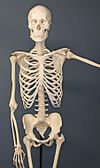 A human skeleton on exhibit at the Museum of Osteology, Oklahoma Urban center, Oklahoma | |
| Details | |
| Identifiers | |
| Greek | σκελετός |
| TA98 | A02.0.00.000 |
| TA2 | 352 |
| Anatomical terminology [edit on Wikidata] | |
The homo skeleton is the internal framework of the homo trunk. It is equanimous of around 270 bones at birth – this total decreases to around 206 basic past machismo after some bones get fused together.[1] The bone mass in the skeleton makes upward about 14% of the full body weight (ca. 10–11 kg for an average person) and reaches maximum density effectually age 21.[ citation needed ] The homo skeleton tin can exist divided into the axial skeleton and the appendicular skeleton. The axial skeleton is formed by the vertebral cavalcade, the rib cage, the skull and other associated bones. The appendicular skeleton, which is attached to the axial skeleton, is formed by the shoulder girdle, the pelvic girdle and the bones of the upper and lower limbs.
The human being skeleton performs six major functions: back up, motility, protection, production of blood cells, storage of minerals, and endocrine regulation.
The human being skeleton is not as sexually dimorphic equally that of many other primate species, merely subtle differences between sexes in the morphology of the skull, dentition, long bones, and pelvis be. In general, female skeletal elements tend to exist smaller and less robust than respective male elements within a given population.[ citation needed ] The human female pelvis is likewise unlike from that of males in social club to facilitate childbirth.[two] Unlike virtually primates, human males practice non accept penile basic.[3]
Divisions
Centric
The axial skeleton (80 bones) is formed by the vertebral cavalcade (32–34 basic; the number of the vertebrae differs from human to human as the lower 2 parts, sacral and coccygeal os may vary in length), a office of the rib cage (12 pairs of ribs and the sternum), and the skull (22 bones and vii associated basic).
The upright posture of humans is maintained by the axial skeleton, which transmits the weight from the head, the trunk, and the upper extremities downward to the lower extremities at the hip joints. The bones of the spine are supported past many ligaments. The erector spinae muscles are also supporting and are useful for residue.
Appendicular
The appendicular skeleton (126 bones) is formed by the pectoral girdles, the upper limbs, the pelvic girdle or pelvis, and the lower limbs. Their functions are to make locomotion possible and to protect the major organs of digestion, excretion and reproduction.
Functions
The skeleton serves six major functions: support, movement, protection, product of blood cells, storage of minerals and endocrine regulation.
Support
The skeleton provides the framework which supports the body and maintains its shape. The pelvis, associated ligaments and muscles provide a flooring for the pelvic structures. Without the rib cages, costal cartilages, and intercostal muscles, the lungs would collapse.
Movement
The joints betwixt bones allow motility, some assuasive a wider range of motility than others, eastward.g. the ball and socket joint allows a greater range of movement than the pivot joint at the neck. Move is powered by skeletal muscles, which are fastened to the skeleton at various sites on bones. Muscles, bones, and joints provide the principal mechanics for movement, all coordinated by the nervous system.
It is believed that the reduction of human os density in prehistoric times reduced the agility and dexterity of human motion. Shifting from hunting to agriculture has caused human bone density to reduce significantly.[4] [5] [half-dozen]
Protection
The skeleton helps to protect many vital internal organs from being damaged.
- The skull protects the brain
- The vertebrae protect the spinal cord.
- The rib cage, spine, and sternum protect the lungs, centre and major blood vessels.
Claret jail cell product
The skeleton is the site of haematopoiesis, the evolution of blood cells that takes place in the bone marrow. In children, haematopoiesis occurs primarily in the marrow of the long bones such as the femur and tibia. In adults, information technology occurs mainly in the pelvis, attic, vertebrae, and sternum.[7]
Storage
The bone matrix can store calcium and is involved in calcium metabolism, and bone marrow can store iron in ferritin and is involved in fe metabolism. However, bones are not entirely made of calcium, simply a mixture of chondroitin sulfate and hydroxyapatite, the latter making up 70% of a bone. Hydroxyapatite is in turn composed of 39.8% of calcium, 41.4% of oxygen, 18.5% of phosphorus, and 0.ii% of hydrogen past mass. Chondroitin sulfate is a sugar made up primarily of oxygen and carbon.
Endocrine regulation
Bone cells release a hormone called osteocalcin, which contributes to the regulation of blood sugar (glucose) and fat degradation. Osteocalcin increases both the insulin secretion and sensitivity, in add-on to boosting the number of insulin-producing cells and reducing stores of fat.[8]
Sex differences

During construction of the York to Scarborough Railway Bridge in 1901, workmen discovered a big stone coffin, close to the River Ouse. Inside was a skeleton, accompanied past an array of unusual and expensive objects. This take chances find represents one of the most meaning discoveries always made from Roman York. Study of the skeleton has revealed that it belonged to a woman.
Anatomical differences between human males and females are highly pronounced in some soft tissue areas, but tend to be limited in the skeleton. The human skeleton is not as sexually dimorphic as that of many other primate species, only subtle differences between sexes in the morphology of the skull, dentition, long bones, and pelvis are exhibited across human populations. In general, female skeletal elements tend to be smaller and less robust than respective male elements inside a given population.[ citation needed ] It is not known whether or to what extent those differences are genetic or environmental.
Skull
A variety of gross morphological traits of the human skull demonstrate sexual dimorphism, such as the median nuchal line, mastoid processes, supraorbital margin, supraorbital ridge, and the chin.[9]
Dentition
Human being inter-sex dental dimorphism centers on the canine teeth, but it is non nigh as pronounced equally in the other great apes.
Long basic
Long bones are generally larger in males than in females within a given population. Muscle attachment sites on long bones are often more robust in males than in females, reflecting a difference in overall musculus mass and development between sexes. Sexual dimorphism in the long bones is commonly characterized by morphometric or gross morphological analyses.
Pelvis
The human pelvis exhibits greater sexual dimorphism than other bones, specifically in the size and shape of the pelvic crenel, ilia, greater sciatic notches, and the sub-pubic angle. The Phenice method is usually used to determine the sex activity of an unidentified human skeleton by anthropologists with 96% to 100% accuracy in some populations.[x]
Women's pelvises are wider in the pelvic inlet and are wider throughout the pelvis to let for child birth. The sacrum in the women'southward pelvis is curved inward to allow the child to accept a "funnel" to assist in the child'south pathway from the uterus to the birth canal.
Clinical significance
There are many classified skeletal disorders. Ane of the nearly common is osteoporosis. Also common is scoliosis, a side-to-side bend in the back or spine, often creating a pronounced "C" or "Due south" shape when viewed on an x-ray of the spine. This status is about apparent during adolescence, and is most common with females.
Arthritis
Arthritis is a disorder of the joints. It involves inflammation of one or more joints. When affected by arthritis, the joint or joints affected may be painful to movement, may movement in unusual directions or may be immobile completely. The symptoms of arthritis will vary differently between types of arthritis. The most mutual form of arthritis, osteoarthritis, tin impact both the larger and smaller joints of the human being skeleton. The cartilage in the affected joints will dethrone, soften and wear away. This decreases the mobility of the joints and decreases the infinite betwixt bones where cartilage should be.
Osteoporosis
Osteoporosis is a disease of bone where in that location is reduced bone mineral density, increasing the likelihood of fractures.[11] Osteoporosis is defined past the World Wellness Organization in women equally a bone mineral density 2.5 standard deviations below peak bone mass, relative to the age and sexual practice-matched average, as measured by Dual free energy Ten-ray absorptiometry, with the term "established osteoporosis" including the presence of a fragility fracture.[12] Osteoporosis is most common in women afterwards menopause, when it is called "postmenopausal osteoporosis", but may develop in men and premenopausal women in the presence of item hormonal disorders and other chronic diseases or as a issue of smoking and medications, specifically glucocorticoids.[eleven] Osteoporosis commonly has no symptoms until a fracture occurs.[11] For this reason, DEXA scans are often washed in people with one or more risk factors, who have adult osteoporosis and be at take a chance of fracture.[eleven]
Osteoporosis treatment includes advice to end smoking, decrease alcohol consumption, exercise regularly, and have a healthy diet. Calcium supplements may besides be brash, as may Vitamin D. When medication is used, information technology may include bisphosphonates, Strontium ranelate, and osteoporosis may exist one factor considered when commencing Hormone replacement therapy.[eleven]
History
![[icon]](https://upload.wikimedia.org/wikipedia/commons/thumb/1/1c/Wiki_letter_w_cropped.svg/20px-Wiki_letter_w_cropped.svg.png) | This department needs expansion. You can help by adding to it. (Nov 2014) |
India
Suśruta-saṃhitā, composed between 6th century BCE and fifth century CE speaks of 360 basic. Books on Salya-Shastra (surgical science) know of only 300. The text and so lists the total of 300 as follows: 120 in the extremities (eastward.1000. hands, legs), 117 in the pelvic area, sides, back, abdomen and chest, and 63 in the neck and upwards.[13] The text then explains how these subtotals were empirically verified.[14] The discussion shows that the Indian tradition nurtured diversity of idea, with Sushruta schoolhouse reaching its own conclusions and differing from the Atreya-Caraka tradition.[14] The differences in the count of bones in the two schools is partly considering Charaka Samhita includes thirty 2 teeth sockets in its count, and their deviation of opinions on how and when to count a cartilage as bone (both count cartilages as bones, unlike current medical do).[15]
Hellenistic world
The study of bones in aboriginal Hellenic republic started nether Ptolemaic kings due to their link to Egypt. Herophilos, through his work by studying dissected human corpses in Alexandria, is credited to exist the pioneer of the field. His works are lost but are frequently cited by notable persons in the field such equally Galen and Rufus of Ephesus. Galen himself did little dissection though and relied on the work of others similar Marinus of Alexandria,[16] as well equally his own observations of gladiator cadavers and animals.[17] According to Katherine Park, in medieval Europe dissection continued to be good, contrary to the popular understanding that such practices were taboo and thus completely banned.[18] The practice of holy autopsy, such as in the case of Clare of Montefalco farther supports the claim.[19] Alexandria continued every bit a middle of beefcake under Islamic rule, with Ibn Zuhr a notable figure. Chinese understandings are divergent, as the closest corresponding concept in the medicinal system seems to be the meridians, although given that Hua Tuo regularly performed surgery, there may be some distance between medical theory and actual understanding.
Renaissance
Leonardo da Vinci made studies of the skeleton, admitting unpublished in his time.[xx] Many artists, Antonio del Pollaiuolo being the first, performed dissections for ameliorate understanding of the body, although they concentrated by and large on the muscles.[21] Vesalius, regarded as the founder of mod anatomy, authored the book De humani corporis fabrica, which independent many illustrations of the skeleton and other body parts, correcting some theories dating from Galen, such equally the lower jaw beingness a unmarried os instead of two.[22] Various other figures like Alessandro Achillini as well contributed to the further understanding of the skeleton.
18th century
As early as 1797, the expiry goddess or folk saint known equally Santa Muerte has been represented as a skeleton.[23] [24]
Encounter also
- List of bones of the human being skeleton
- Distraction osteogenesis
References
- ^ Mammal anatomy : an illustrated guide. New York: Marshall Cavendish. 2010. p. 129. ISBN9780761478829.
- ^ Thieme Atlas of Anatomy, (2006), p 113
- ^ Patterns of Sexual Behavior Clellan S. Ford and Frank A. Beach, published past Harper & Row, New York in 1951. ISBN 0-313-22355-6
- ^ "Switching Farming Fabricated Human Bone Skeleton Joint Lighter". Smithsonian Magazine. 23 Dec 2014.
- ^ "Light human being skeleton may have come after agronomics". Retrieved iv March 2017.
- ^ "With the Advent of Agriculture, Man Bones Dramatically Weakened". 22 December 2014. Retrieved 4 March 2017.
- ^ Fernández, KS; de Alarcón, PA (Dec 2013). "Development of the hematopoietic arrangement and disorders of hematopoiesis that nowadays during infancy and early childhood". Pediatric Clinics of North America. 60 (vi): 1273–89. doi:10.1016/j.pcl.2013.08.002. PMID 24237971.
- ^ Lee, Na Kyung; Sowa, Hideaki; Hinoi, Eiichi; Ferron, Mathieu; Ahn, Jong Deok; Confavreux, Cyrille; Dacquin, Romain; Mee, Patrick J.; McKee, Marc D.; Jung, Dae Young; Zhang, Zhiyou; Kim, Jason M.; Mauvais-Jarvis, Franck; Ducy, Patricia; Karsenty, Gerard (2007). "Endocrine Regulation of Energy Metabolism by the Skeleton". Jail cell. 130 (3): 456–69. doi:10.1016/j.prison cell.2007.05.047. PMC2013746. PMID 17693256.
- ^ Buikstra, J.Due east.; D.H. Ubelaker (1994). Standards for information collection from human being skeletal remains. Arkansas Archaeological Survey. p. 208.
- ^ Phenice, T. W. (1969). "A newly developed visual method of sexing the bone pubis". American Journal of Physical Anthropology. 30 (2): 297–301. doi:10.1002/ajpa.1330300214. PMID 5772048.
- ^ a b c d e Britton, the editors Nicki R. Colledge, Brian R. Walker, Stuart H. Ralston; illustrated by Robert (2010). Davidson'due south principles and exercise of medicine (21st ed.). Edinburgh: Churchill Livingstone/Elsevier. pp. 1116–1121. ISBN978-0-7020-3085-7.
- ^ WHO (1994). "Assessment of fracture run a risk and its awarding to screening for postmenopausal osteoporosis. Report of a WHO Study Grouping". World Health Organisation Technical Report Serial. 843: 1–129. PMID 7941614.
- ^ Hoernle 1907, p. seventy.
- ^ a b Hoernle 1907, pp. seventy–72.
- ^ Hoernle 1907, pp. 73–74.
- ^ Rocca, Julius (9 August 2010). "A Notation on Marinus of Alexandria". Journal of the History of the Neurosciences. 11 (3): 282–285. doi:10.1076/jhin.11.three.282.10386. PMID 12481479. S2CID 37476347.
- ^ Charlier, Philippe; Huynh-Charlier, Isabelle; Poupon, Joël; Lancelot, Eloïse; Campos, Paula F.; Favier, Dominique; Jeannel, Gaël-François; Bonati, Maurizio Rippa; Grandmaison, Geoffroy Lorin de la; Herve, Christian (2014). "Special report: Anatomical pathology A glimpse into the early origins of medieval anatomy through the oldest conserved human dissection (Western Europe, 13th c. A.D.)". Archives of Medical Science. 2 (2): 366–373. doi:10.5114/aoms.2013.33331. PMC4042035. PMID 24904674.
- ^ "Debunking a myth". Harvard Gazette . Retrieved 12 November 2016.
- ^ Hairston, Julia L.; Stephens, Walter (2010). The torso in early modern Italian republic. Baltimore: Johns Hopkins University Press. ISBN9780801894145.
- ^ Sooke, Alastair. "Leonardo da Vinci: Anatomy of an creative person". Telegraph.co.uk . Retrieved 9 Dec 2016.
- ^ Bambach, Carmen. "Anatomy in the Renaissance". The Met's Heilbrunn Timeline of Art History.
- ^ "Vesalius'south Renaissance anatomy lessons". www.bl.uk . Retrieved 18 December 2016.
- ^ Chesnut, R. Andrew (2018) [2012]. Devoted to Death: Santa Muerte, the Skeleton Saint (Second ed.). New York: Oxford University Press. doi:10.1093/acprof:oso/9780199764662.001.0001. ISBN978-0-nineteen-063332-5. LCCN 2011009177. Retrieved 2021-xi-30 .
- ^ Livia Gershon (October 5, 2020). "Who is Santa Muerte?". JSTOR Daily. Retrieved 2021-11-xxx .
Bibliography
- Hoernle, A. F. Rudolf (1907). Studies in the Medicine of Ancient India: Osteology or the Bones of the Human Body. Oxford, United kingdom of great britain and northern ireland: Clarendon Printing.
Source: https://en.wikipedia.org/wiki/Human_skeleton
Posted by: dangeloancell1948.blogspot.com
0 Response to "How Many Bones Makeup The Skeletal System? 3 Points How Many Bones Makeup The Skeletal System?"
Post a Comment