

How Is The Demographic Makeup Of Congress Quizlet
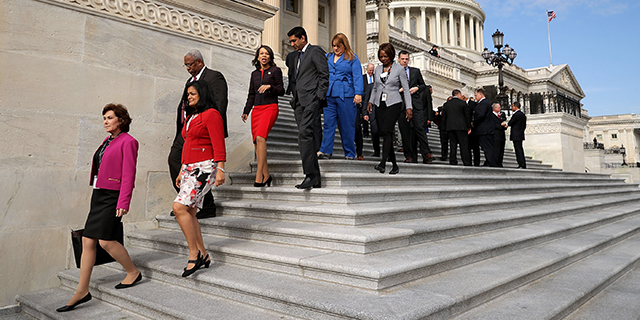
Almost one-in-v voting members of the Firm and Senate are a racial or ethnic minority, making the 115th U.South. Congress the well-nigh diverse in history. And while Congress as a whole remains disproportionately white when compared with the U.S. population, the racial and ethnic contour of newly elected members more closely resembles the increasingly diverse populace, according to a Pew Research Center assay.
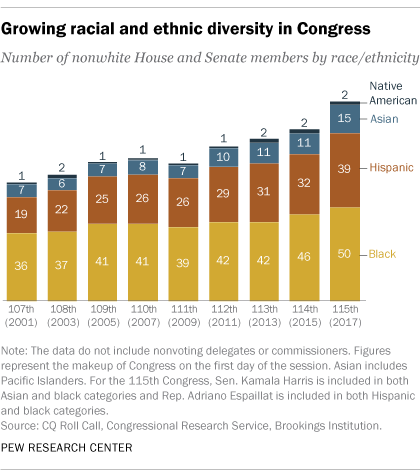 Overall, nonwhites (including blacks, Hispanics, Asians/Pacific Islanders and Native Americans) make upwardly nineteen% of the current Congress. By comparison, nonwhite Hispanics and other racial minorities make upwards 38% of the nation's population.
Minorities, however, account for twenty of 59 new members (34%) of the House and Senate. This represents a notable jump over the 114th Congress, when just 11 of 71 new members (15%) were a racial or ethnic minority and the Senate had no newly elected minority members. This year, three freshman senators are a racial or ethnic minority, along with 17 new members of the Business firm.
Multifariousness in Congress has been growing for decades, though it has lagged behind the diversity of the nation as a whole. In 1981, 6% of members of Congress were a minority, while the national population was nigh twenty% nonwhite. When the 107th Congress took office in 2001, minorities accounted for 12% of all members, compared with well-nigh 31% of the nation's population.
 Among minority groups in Congress, the biggest growth over time has been amongst Hispanics and Asians, both of whom accept doubled their representation in the national legislature since 2001. Today, there are 39 Hispanics and 15 Asians in part, up from 19 Hispanics and seven Asians in the 107th Congress.
The increasing number of minorities in Congress is due largely to changes in the Firm, where today 95 of 435 members (22%) are nonwhite, co-ordinate to CQ Curlicue Telephone call. By comparison, in that location were lx minorities in the Firm in 2001. In the Senate, x of 100 members now belong to a racial or ethnic minority group, upwards from iii in 2001.
House minority increases have largely come among newly elected Democrats, though Republicans take also seen an uptick. Since 2001, the number of House Democrats who are minorities increased by 27, from 56 and so to 83 at present. At that place was an increase of eight representatives amongst House Republicans over the same period, ascension from four and then to 12 now.
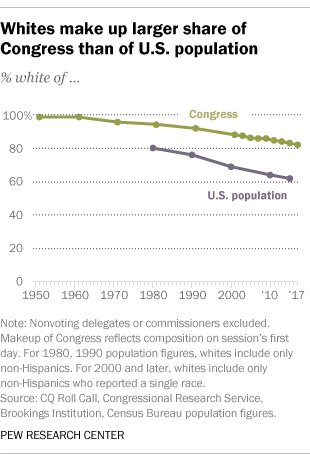
Despite the increase in nonwhite representation in Congress, whites account for 81% of the current Congress merely represent simply 62% of the population. This gap has widened over time. In 1981, 94% of Congress was white, compared with about 80% of the U.S. population.
Correction: A previous version of this mail service gave an incorrect total for minority House members in the 115th Congress. The House totals by party remain correct.
Note: For analysis of the previous Congress, encounter: 114th Congress is most various e'er.
Related posts:
The changing face up of Congress in five charts
Congressional productivity is upwardly – just many new laws overturn Obama-era rules

Kristen Bialik is a former research assistant at Pew Research Centre.

Source: https://www.pewresearch.org/fact-tank/2017/01/24/115th-congress-sets-new-high-for-racial-ethnic-diversity/
Posted by: dangeloancell1948.blogspot.com
0 Response to "How Is The Demographic Makeup Of Congress Quizlet"
Post a Comment